
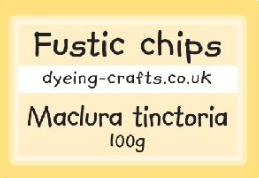

FUSTIC CHIPS
£6.00
Description
Related to the Mulberry tree. The dye comes from the inner wood of the trunk.
Dyeing with fustic chips produces a range of colours from strong dark yellows to dark greens.
100g – £5.50
Additional information
| Weight | 0.1 kg |
|---|
Related products
INDIGO (NATURAL)
Indigofera tinctoria This ancient dyestuff produces the familiar indigo blue used for batik work. There are many ways to make an indigo
£8.50Add to basket
INDIGO (NATURAL)
Indigofera tinctoria This ancient dyestuff produces the familiar indigo blue used for batik work. There are many ways to make an indigo
£8.50Add to basket

LOGWOOD CHIPS
(Haematoxylum campechianum) Logwood comes from a tree native to the West Indies and the Yucatan Peninsula. With alum it gives purple to
£8.50Read more
LOGWOOD CHIPS
(Haematoxylum campechianum) Logwood comes from a tree native to the West Indies and the Yucatan Peninsula. With alum it gives purple to
£8.50Read more
MADDER CHOPPED
Madder The roots of this ancient plant are rich in red alizarin and are the source of a strong red dye. The
£6.50Add to basket
MADDER CHOPPED
Madder The roots of this ancient plant are rich in red alizarin and are the source of a strong red dye. The
£6.50Add to basket

WALNUT
(juglans nigra) I am so fortunate to have a magnificent walnut tree in the garden and from which I am able to
£4.50Add to basket
WALNUT
(juglans nigra) I am so fortunate to have a magnificent walnut tree in the garden and from which I am able to
£4.50Add to basket
